What is infrared photography?
NEAR-INFRARED700–1000 NMHOW THE PICTURES ARE MADE
Near-infrared is light with wavelengths just longer than the eye can see, roughly 700 to 1000 nanometres. Living foliage reflects it strongly, water absorbs it, and a clear sky scatters little of it.
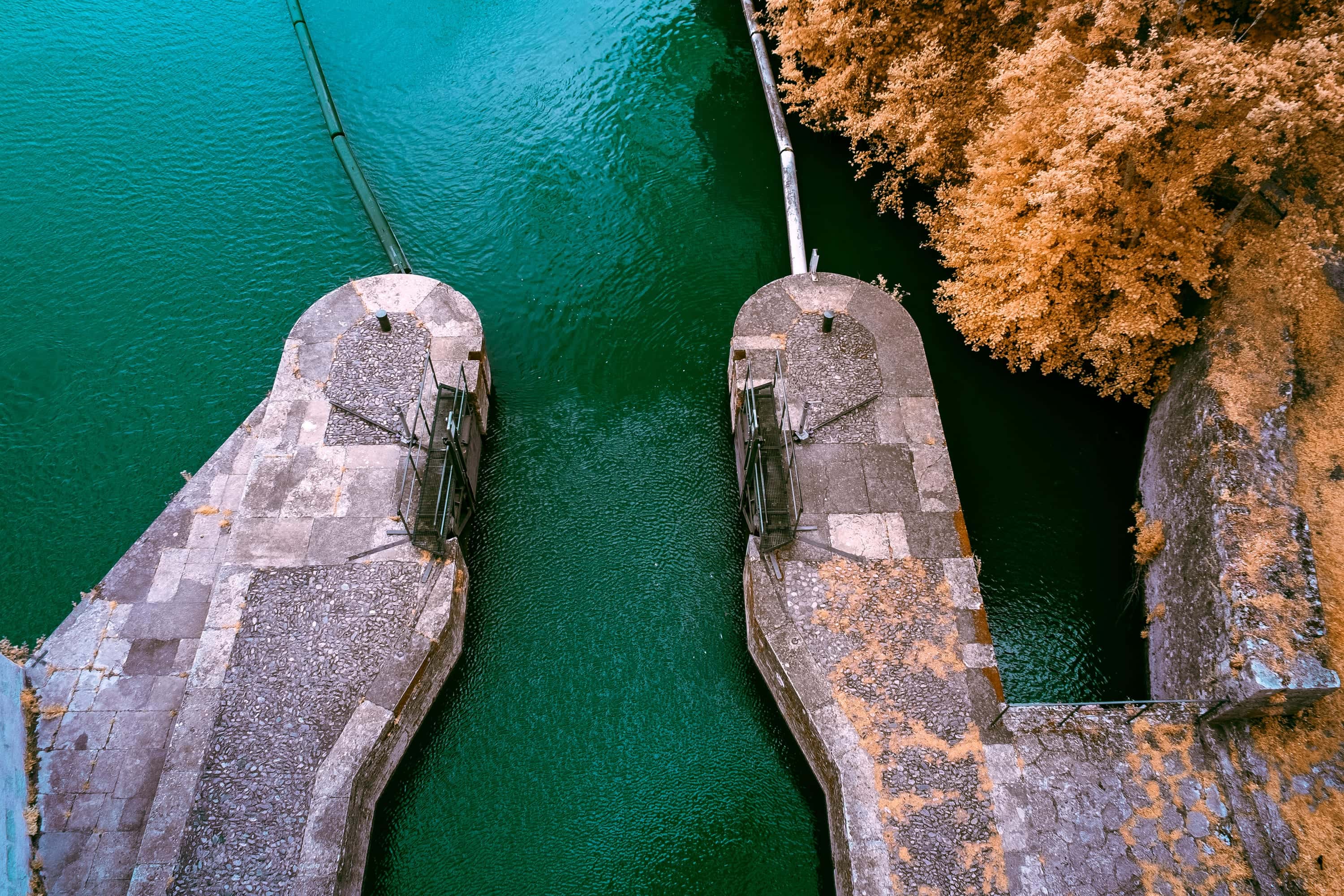
A camera modified to record this band shows leaves as bright and water and sky as dark. The photographs on this site are made this way.
Wavelength
The eye responds to wavelengths of about 400 to 700 nanometres (nm). Near-infrared lies immediately beyond, from about 700 to 1000 nm, and behaves like visible light: it is reflected by surfaces, scattered by the atmosphere, and focused by ordinary glass lenses.
Thermal imaging is a different technique. It records radiation emitted by warm objects at 8,000 to 14,000 nm, more than ten times longer in wavelength, using specialised sensors.[1] A near-infrared photograph contains no temperature information. A cold leaf and a warm leaf render identically; what differs is whether the leaf is alive.
The sensor and the hot mirror
Digital camera sensors are silicon, which responds to light from the ultraviolet to about 1,100 nm.[2] Manufacturers bond an infrared-blocking filter, called a hot mirror, over the sensor so that near-infrared does not contaminate the colour image. Without it, daylight photographs take on a muddy cast and foliage loses definition.
A full-spectrum conversion removes the hot mirror and replaces it with clear glass. The change is permanent. After conversion, a filter on the lens determines which wavelengths reach the sensor, and the amount of visible light that filter admits decides whether the result has colour in it or is effectively monochrome.
Why foliage is bright
Chlorophyll absorbs strongly in the blue and red parts of the visible spectrum and is nearly transparent in the near-infrared.[3] Near-infrared light therefore passes into the leaf, where it is scattered at the many interfaces between cell walls and the air spaces of the spongy mesophyll.[3][4] A healthy leaf reflects roughly 40 to 60 percent of the near-infrared that reaches it, transmits most of the remainder, and absorbs less than about 10 percent.[4] Dead or dry leaves, and cut grass, reflect much less.
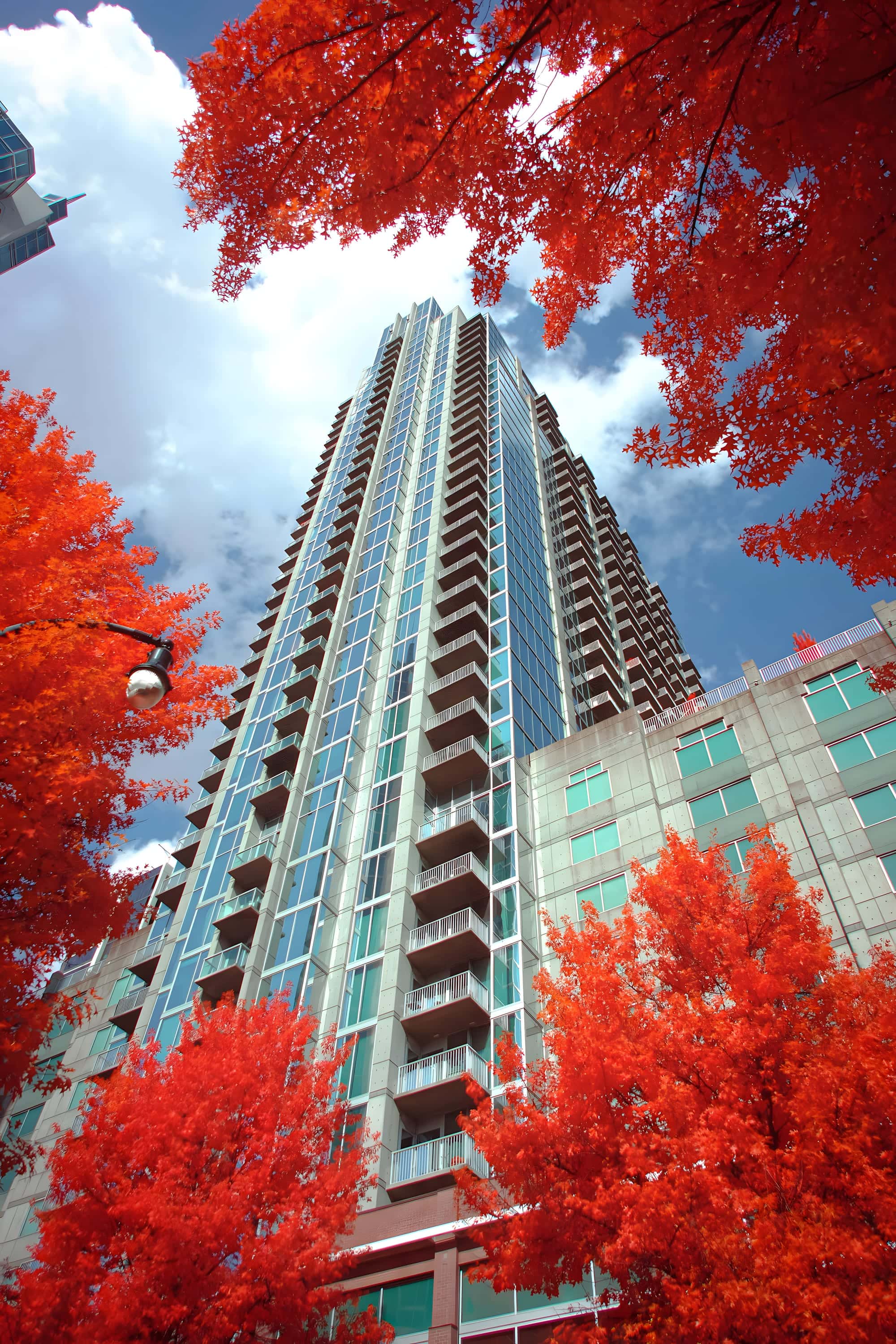
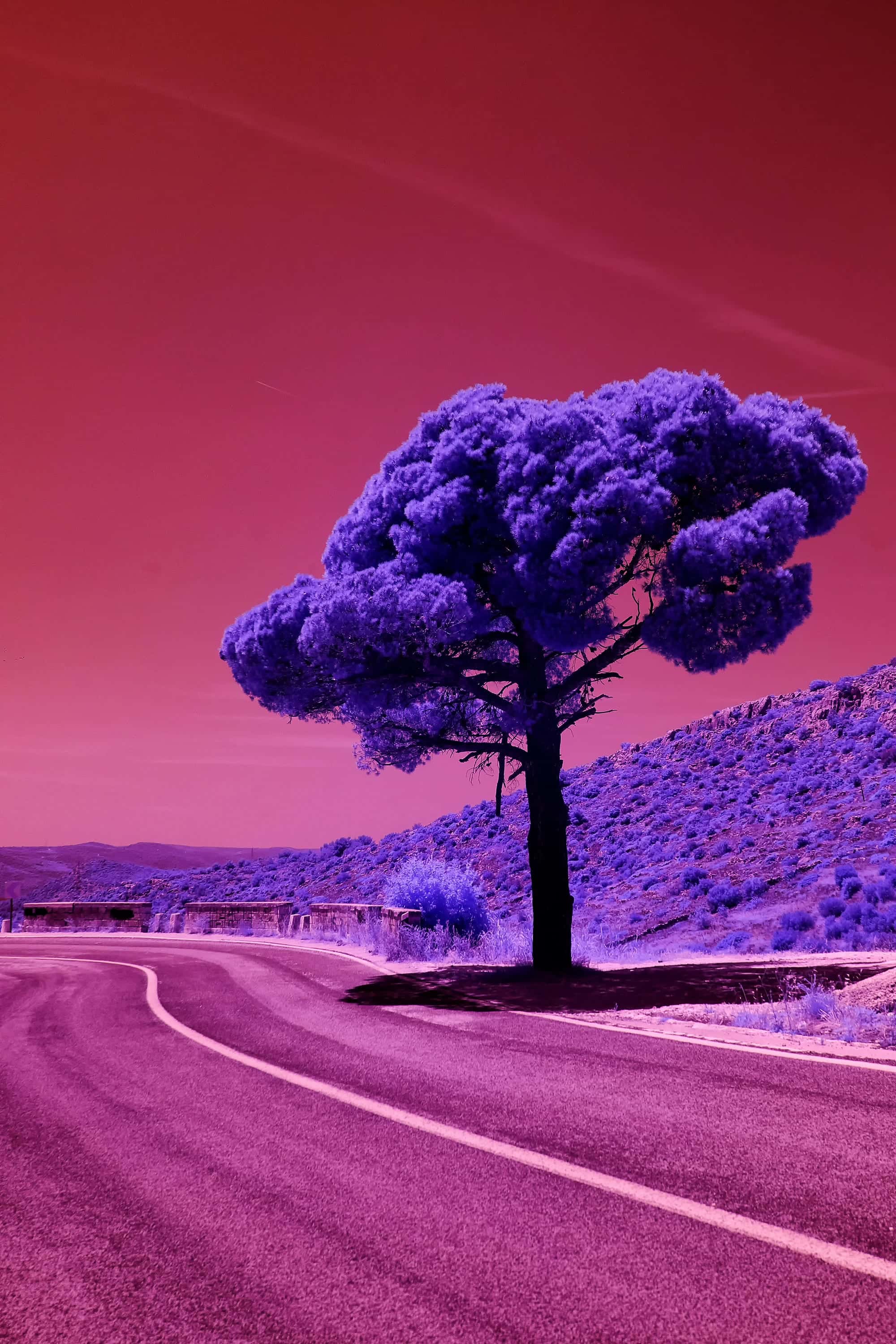
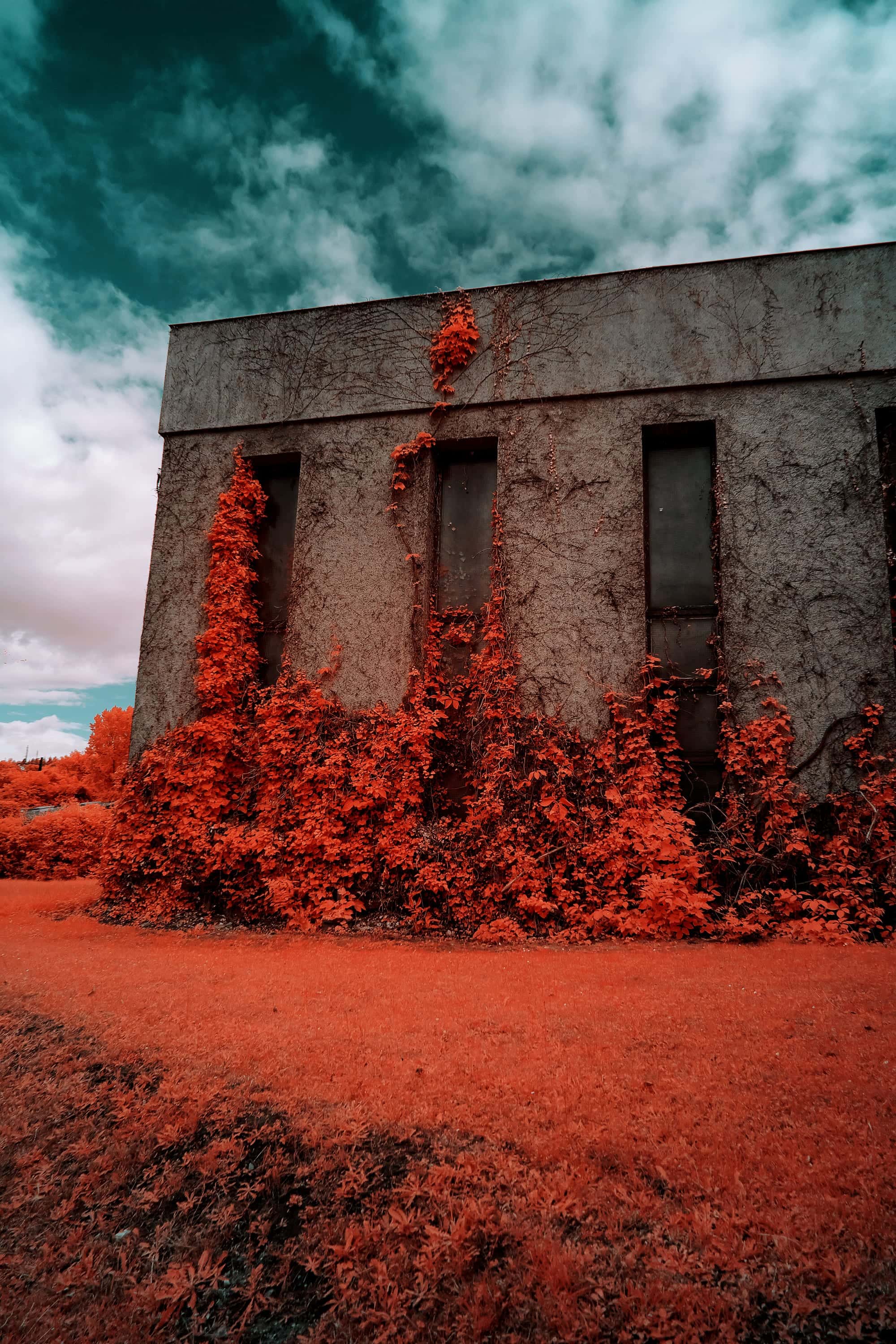
Robert W. Wood published the first infrared landscape photographs in 1910, and the bright rendering of foliage is often called the Wood effect.[5]
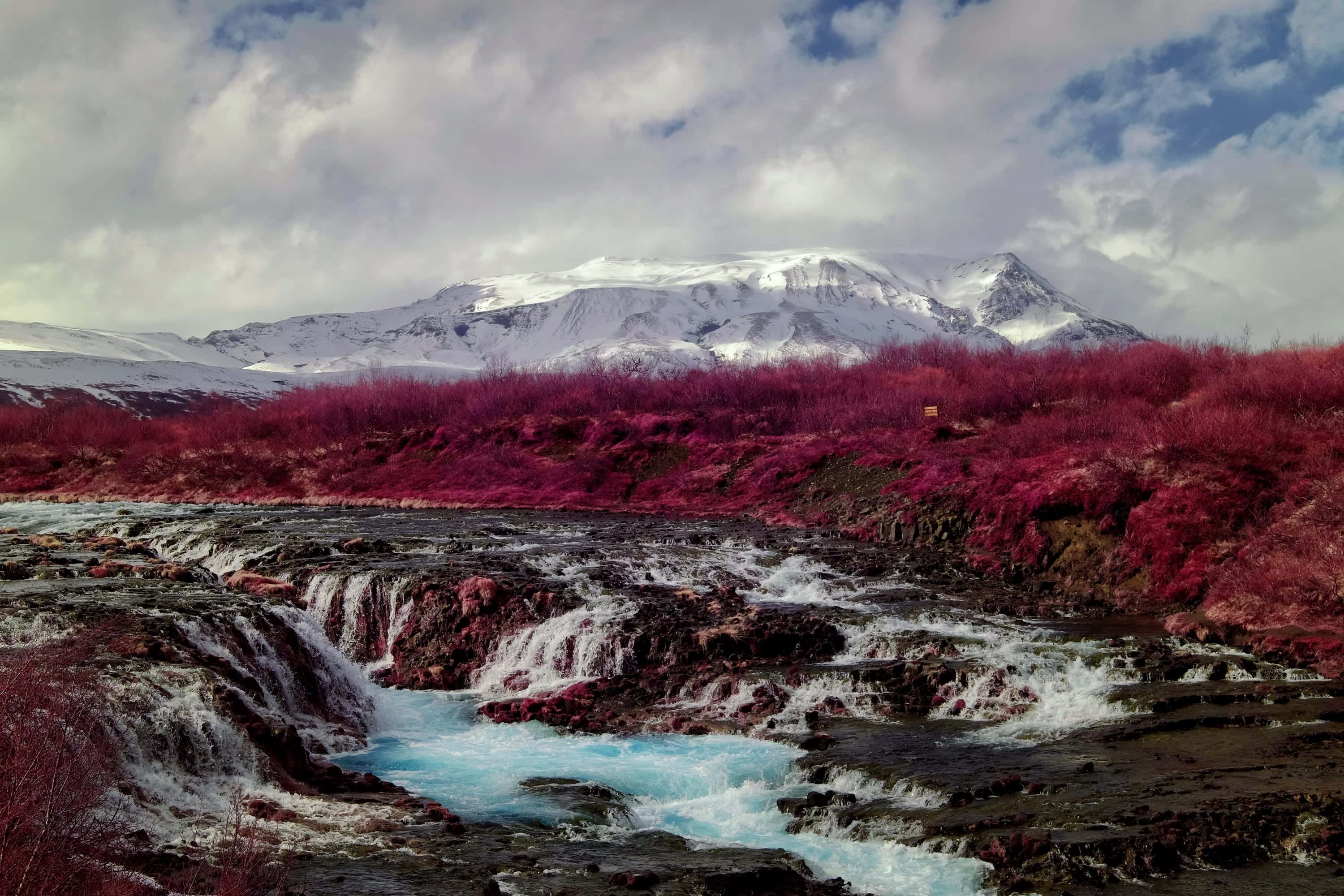
Water absorbs near-infrared far more strongly than it absorbs visible light, so lakes, rivers and wet ground render dark.[6] A clear sky is bright to the eye because air scatters short wavelengths much more than long ones; at near-infrared wavelengths the sky scatters little and renders dark. The contrast between bright vegetation and dark water and sky is a property of the scene at these wavelengths.
What is recorded and what is chosen
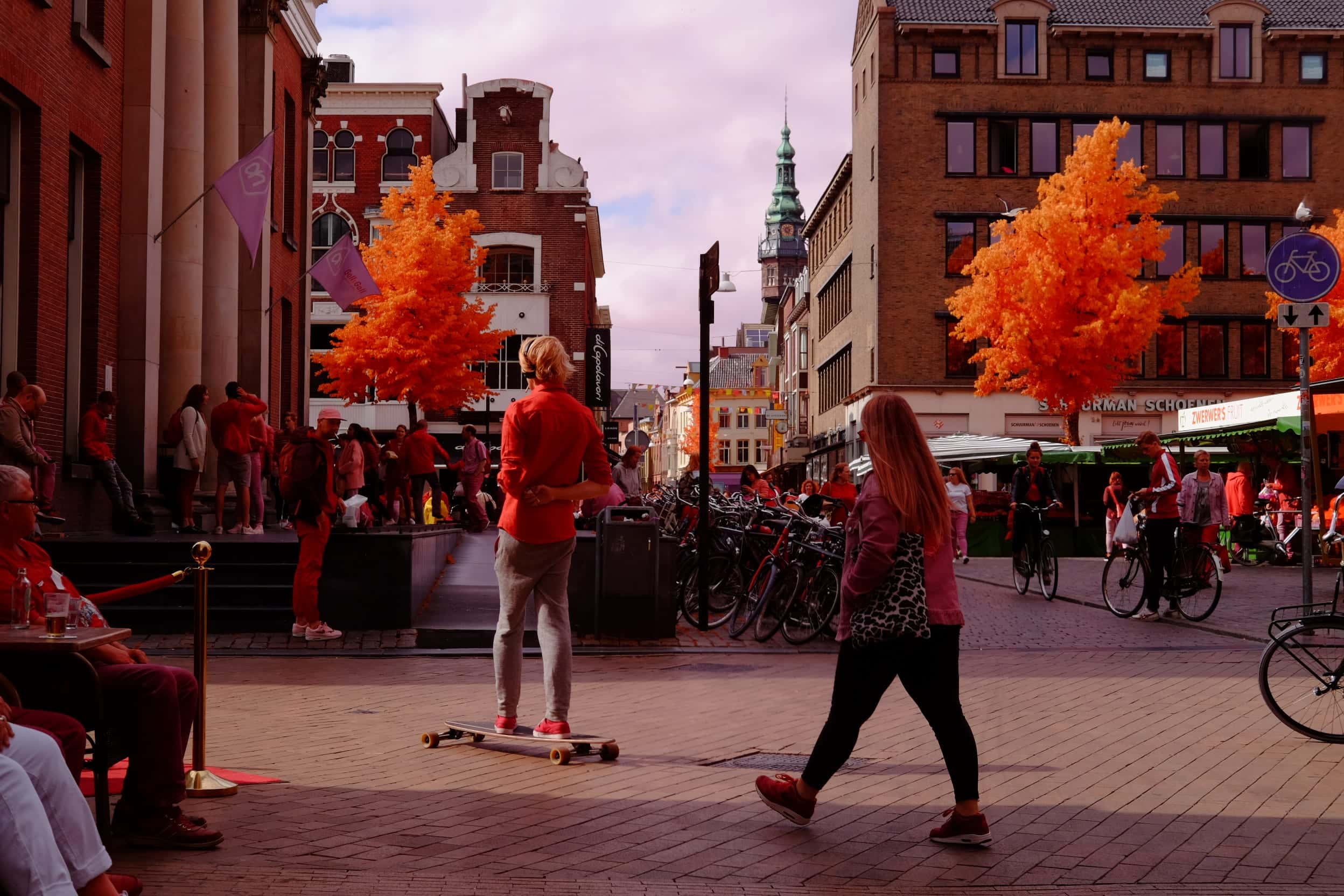
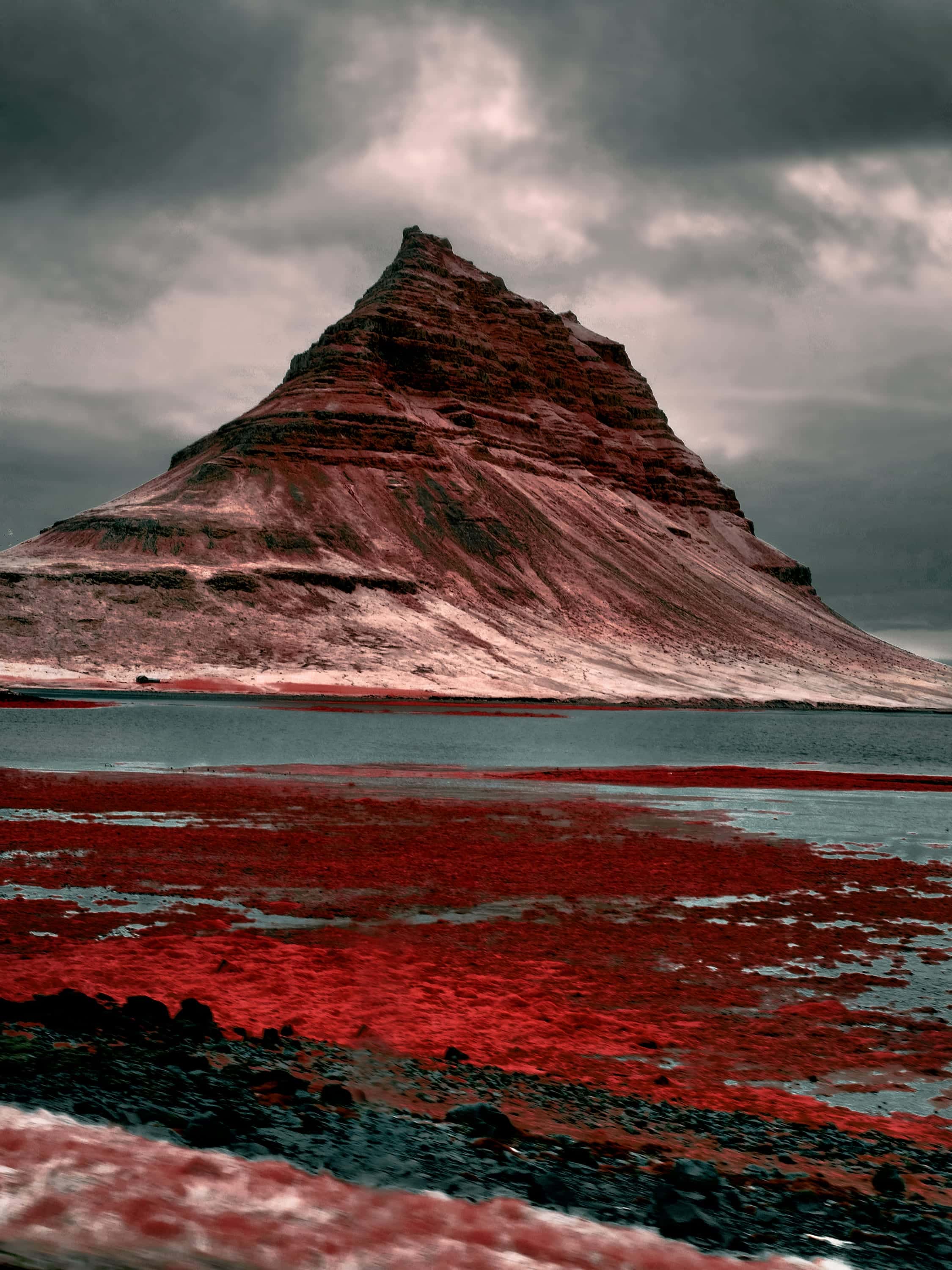
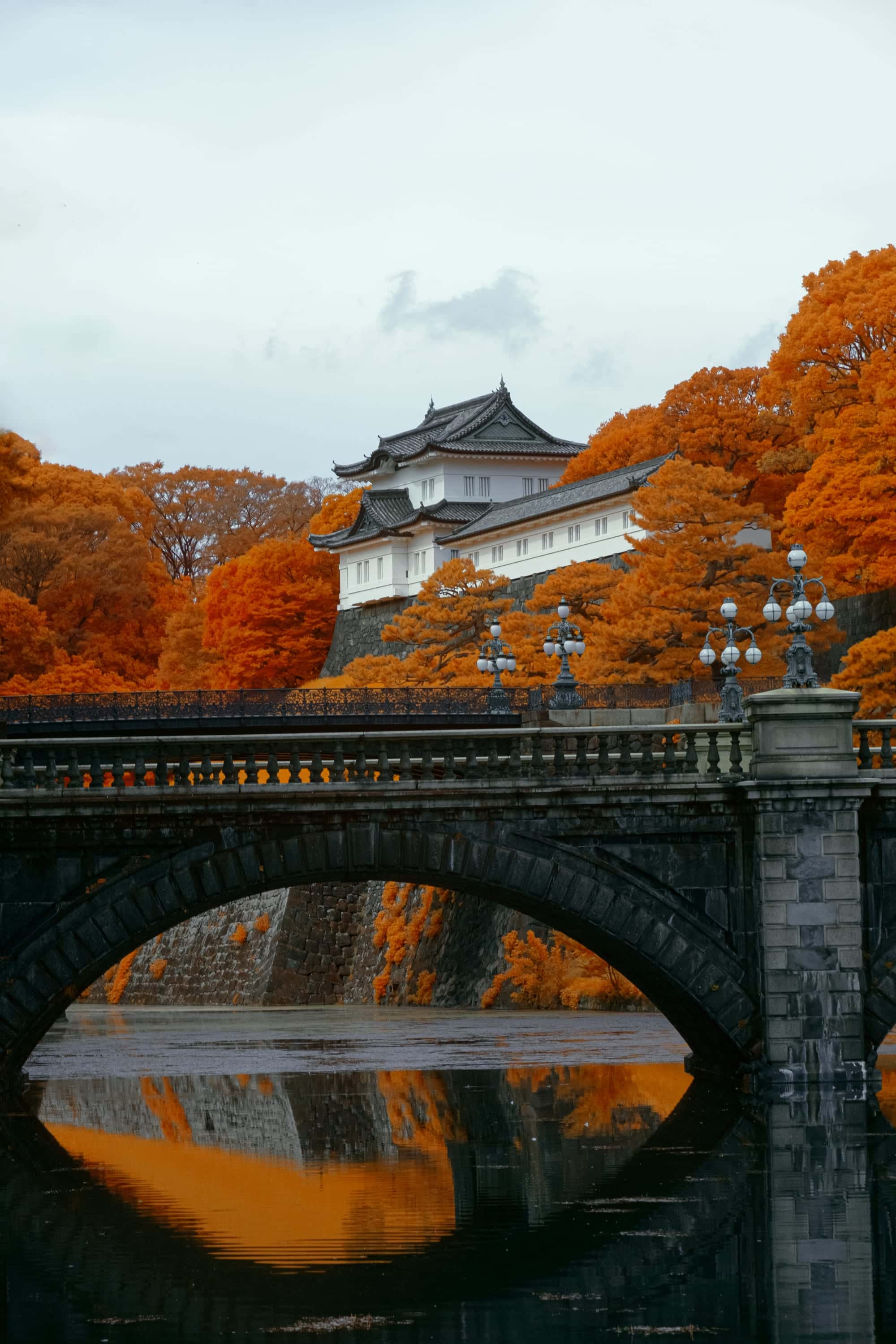
A converted camera with an infrared-pass filter produces a file dominated by the red channel, because the red-filtered pixels of the sensor are the most sensitive to near-infrared. To produce a legible colour image, the file is white-balanced against foliage and, in most cases, the red and blue channels are exchanged. False-colour satellite and aerial imagery use the same convention: the near-infrared band is displayed as red, so vegetation appears red and water appears dark.[7][8]
The photographs on this site are colour-graded, and some are channel-swapped. The tonal relationships (bright foliage, dark water and sky) are recorded by the sensor. The hues are chosen in processing. Neither statement should be read as applying a colour effect to an ordinary photograph: an ordinary photograph does not contain this information at all.

Filters
The filter is named for the wavelength below which it blocks light. Shorter cutoffs admit some visible light and give more colour to work with; longer cutoffs give a purer infrared signal, more contrast, and less colour.
| Cutoff | Passes | Typical result |
|---|---|---|
| 590 nm | near-infrared plus visible orange and red | the most colour: gold and pink foliage, blue sky |
| 665 nm | near-infrared plus a little visible red | pale yellow foliage, deep blue sky |
| 720 nm | near-infrared only | white foliage, dark sky; the usual starting point |
| 850 nm | deeper near-infrared only | no usable colour; a monochrome image |
The photographs on this site
Chris Riehm has photographed in near-infrared since 2016, first on a converted Fujifilm X100, then on converted Nikon bodies, and more recently on a full-spectrum Fujifilm X-T2. No filter wavelength is recorded against individual series, so none is claimed for specific photographs.
One series on this site is not infrared: Giverny was photographed in visible light with the hot mirror in place.
Making an infrared photograph with an unmodified camera
A hot mirror blocks most near-infrared but not all of it. With a longpass filter on the lens, an unmodified camera can record an infrared image by long exposure.
A TEN-SECOND TEST
Point a television remote at the lens and hold a button while watching the live view. A pale violet light visible on the screen and not to the eye is the remote’s near-infrared emitter, recorded by the sensor. Phone cameras show the same thing.
- Photograph living foliage in direct sun. The effect is strongest on healthy leaves under a clear sky. Dead leaves and cut grass reflect little near-infrared.
- Compose and focus before fitting the filter. A 720 nm filter is opaque to the eye and to most autofocus systems. Frame the picture, lock focus, then attach the filter without moving the camera.
- Stop down to about f/8 and disable autofocus. Near-infrared focuses on a slightly different plane from visible light, so a lens focused by eye is marginally soft. Depth of field covers the difference. Older manual lenses carry a red index mark on the distance scale for this purpose.
- Bracket widely and expect exposures of seconds to minutes. The leakage of a hot mirror varies by orders of magnitude between cameras, and the meter is not calibrated for it. A tripod is required.
- Record raw. The frame will be a nearly uniform red. The image is present in the file, and raw retains enough of it to process.
Processing
Set a custom white balance from foliage rather than from a grey card. Many cameras cannot reach the required value and clip; in that case the white balance is set in the raw converter. Exchanging the red and blue channels then produces the familiar false-colour result of blue sky and warm foliage. This step is an interpretation, and it is where the colour of the photographs on this site is decided.
Two known problems
Hot spots. Some lenses produce a bright patch at the centre of the frame under near-infrared, caused by reflections from their internal coatings. It is a property of the lens. Infrared photographers maintain lists of lenses that are free of it.
Loss of colour. Filters at 850 nm and beyond admit no visible light, so the image has no colour to interpret and is effectively monochrome. See the table above.
A full-spectrum conversion removes the hot mirror permanently, restores hand-held exposure times, and leaves the filter on the lens to decide what is recorded. Because it cannot be reversed, it is usually done to a second camera body.
References
- [1]Vollmer, M., & Möllmann, K.-P. (2018). Infrared Thermal Imaging: Fundamentals, Research and Applications (2nd ed.). Wiley-VCH. Thermal cameras operate in the 8 to 14 µm (8,000 to 14,000 nm) band.
- [2]Sze, S. M., & Ng, K. K. (2007). Physics of Semiconductor Devices (3rd ed.). Wiley. Silicon has a band gap of 1.12 eV at room temperature, which sets its long-wavelength limit near 1,100 nm.
- [3]Gates, D. M., Keegan, H. J., Schleter, J. C., & Weidner, V. R. (1965). Spectral properties of plants. Applied Optics, 4(1), 11–20. opg.optica.org/ao/abstract.cfm?uri=ao-4-1-11
- [4]Knipling, E. B. (1970). Physical and physiological basis for the reflectance of visible and near-infrared radiation from vegetation. Remote Sensing of Environment, 1(3), 155–159. www.sciencedirect.com/science/article/abs/pii/S0034425770800219
- [5]Wood, R. W. (1910). A new departure in photography. The Century Illustrated Monthly Magazine, February 1910. Also: Wood, R. W. (1910). Photography by invisible rays. The Photographic Journal, October 1910 (Traill-Taylor Memorial Lecture, Royal Photographic Society).
- [6]Hale, G. M., & Querry, M. R. (1973). Optical constants of water in the 200-nm to 200-µm wavelength region. Applied Optics, 12(3), 555–563. Water absorption rises steeply through the near-infrared.
- [7]NASA Earth Observatory (2014). Why is that forest red and that cloud blue? How to interpret a false-color satellite image. science.nasa.gov/earth/earth-observatory/how-to-interpret-a-false-color-satellite-image
- [8]U.S. Geological Survey. What do the different colors in a color-infrared aerial photograph represent? USGS FAQ. www.usgs.gov/faqs/what-do-different-colors-color-infrared-aerial-photograph-represent
SEE IT ON PAPER
The prints are archival pigment on 100% cotton rag, made to order in the US, in up to three sizes, with free US shipping.
BROWSE THE PRINTS →Questions about the process: cdriehmart@gmail.com.